“Nocturne in a Deserted Brickyard” for SSAATTBB chorus and flute

This piece immediately introduces itself as something out of the ordinary; a textural chord hummed by the choir, and a soaring, rhythmic flute solo as the primary highlight. This flute line is often technically demanding, and serves as a stark contrast to everything else in the work.

The text is a beautiful description of moonlight reflecting off of the surface of a lake.

Stuff of the moon
Runs on the lapping sand
Out to the longest shadows.
Under the curving willows,
And round the creep of the wave line,
Fluxions of yellow and dusk on the waters
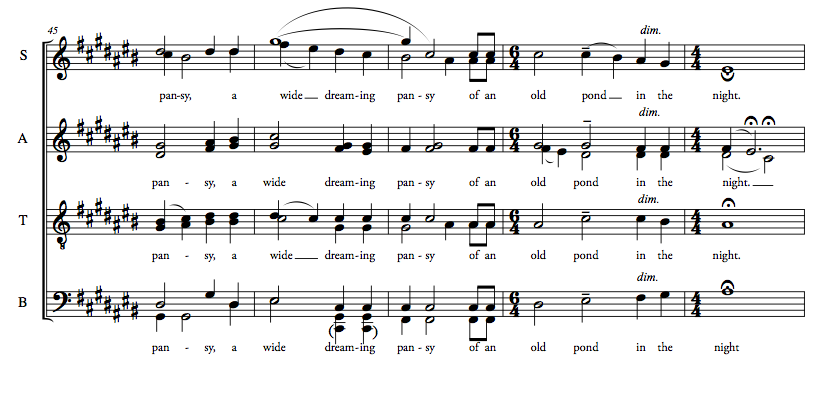
Make a wide dreaming pansy of an old pond in the night

The flute serves as an audial representation of the “fluxions of yellow and dusk” shimmering on the water and shore, whereas the lush texture of the choir underneath it portrays the beauty and reverence of the sight.

The anticipation in the vocal lines grow more intricate and strong as we begin to discover more about the journey of the “stuff of the moon.” Each destination of the moonlight is set in a distinct way, and when we finally arrive at the lake, the music becomes more consonant, yet doubles in power and emotion.
Nocturne in a Deserted Brickyard was written to be challenging for even a semi-professional ensemble of trained singers.

Contact me if you want to give it a try.

“Come, Thou Fount of Every Blessing”

“[Patrick Dunnevant] wasn’t afraid to do some chord substitutions and play with the texture of it while still retaining, I think, the nobility of the original hymn…” – Dave Brown, Mouth Off

Come, Thou Fount of Every Blessing was arranged for the Beltones as my “senior solo” and was first performed in the ensemble’s spring concert on April 29th, 2011. It was also recorded on the group’s first recording, The Beltones, which can be listened to for free and purchased here. It was also performed by the Mills E. Godwin High School Madrigals in Henrico, Virginia.

This arrangement was reviewed and featured in the January 29th, 2012 episode of “Mouth Off,” an a cappella-related podcast. The segment begins at 18:35.

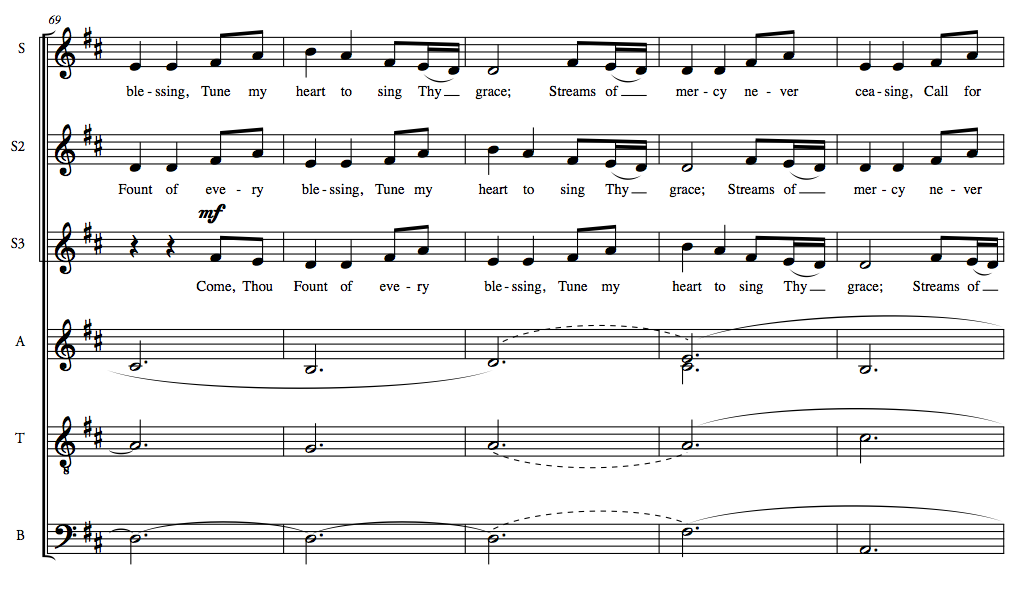
Each section of the work builds dynamically. Even in the opening section, where a single baritone sings the melody by himself, there should be a palpable amount of anticipation of what is to come. The ensemble grows and adds layers of parts and different ostinati with each verse, until the African-influenced fourth verse, when it all breaks loose into a rhythmic frenzy. Shortly afterwards, there is a three-part round on the melody:


This is a tribute to a composition teacher of mine, Deen Entsminger, who employed this in a setting of the Doxology.

Listen to the Beltones perform this arrangement:

Here are the Mills E. Godwin High School Madrigals performing the arrangement:

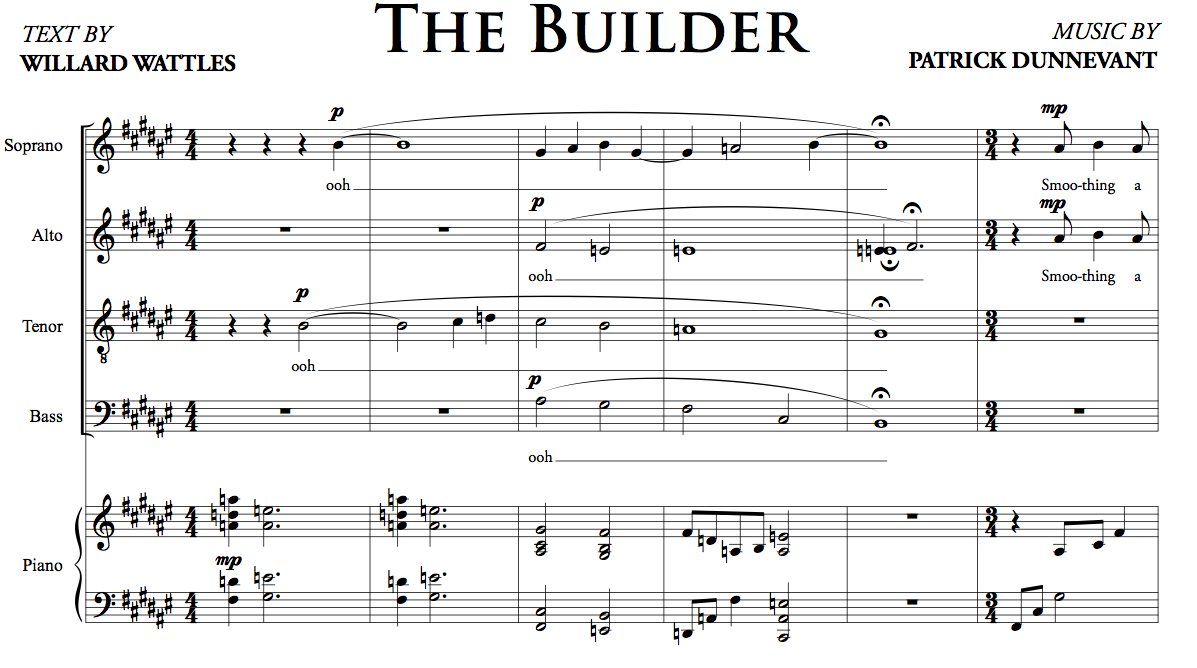
“The Builder” for SATB chorus and piano

Smoothing a cypress beam
With a scarred hand,
I saw a carpenter
In a far land.

Down past the flat roofs
Poured the white sun;
But still he bent his back,
The patient one.

And I paused surprised
In that queer place
To find an old man
With a haunting face.

“Who art thou, carpenter,
Of the bowed head;
And what buildest thou?”
“Heaven,” he said.

This work is dedicated to, and will be premiered by Canticum Novum at Westminster Choir College, under the direction of Vinroy D. Brown, Jr.

As I see it, the last stanza can be interpreted in two ways.The first could be that the very act of building something to him is heavenly; that his craft brings a piece of Heaven down to his daily life here on Earth. The second is a more dark interpretation: that he is escaping the troubles of this life, a Hell on earth, by building Heaven for himself.

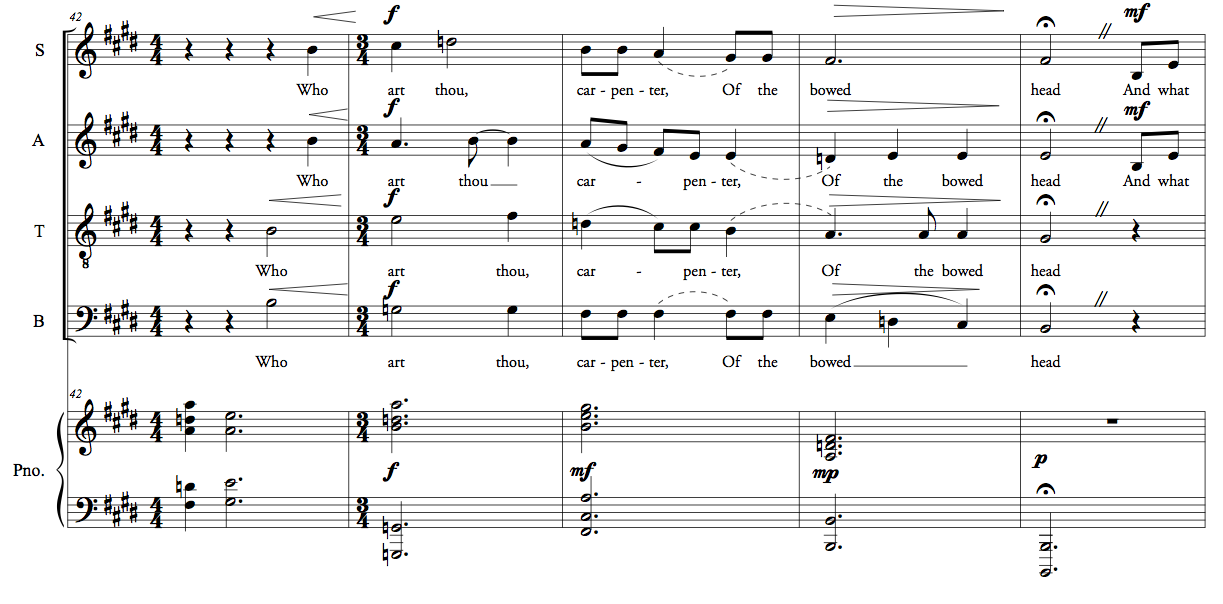
I debated back and forth between these interpretations, and ultimately set the text to convey a little bit of both. Here is the beginning of the climax of the work, where the tonality shifts to an almost melancholy sort of inquisitiveness:

The music behind his one-word response, though utilizing some ethereal, close-knit major chords, also has a sense of uncertainty about it; many of the chords are inverted and dissonant, and we don’t arrive at feeling of cadence until the last chord.

Contact me if you want to give it a try.